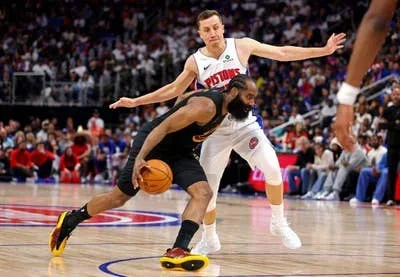
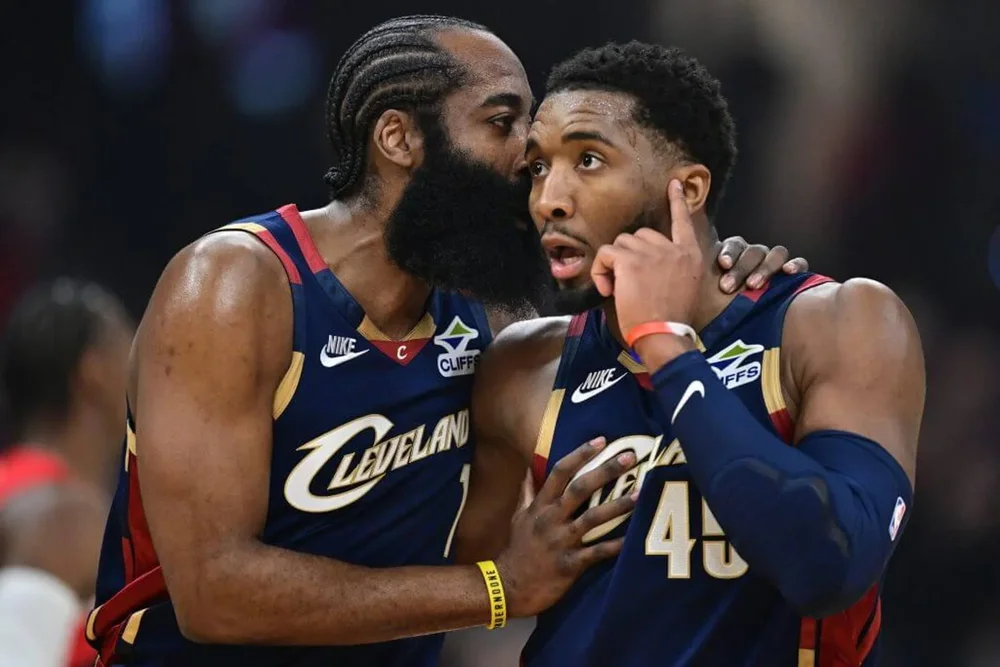
Can James Harden and Donovan Mitchell lead the Cavs past the top-seeded Pistons?
David Dermer / Imagn Images
CLEVELAND — Dressed in a sharp tracksuit and dark tinted glasses that concealed his eyes, Donovan Mitchell brought an unmistakable coolness to the arena. Only the most composed characters wear sunglasses indoors or at night, right?
That vibe reflects Mitchell and, more broadly, his Cavaliers teammates and coaches throughout this unpredictable 2026 postseason. After blowing Game 6 in Toronto on a lucky bounce? No panic—just a vow to “protect home court” in Game 7, as Mitchell put it. After dropping the first two games of the second round in Detroit, knowing no NBA team has ever erased a 3-0 series deficit? Fine—Mitchell slipped on that tracksuit, showed up at the gym, and casually dropped 35 points with 10 rebounds, leading the Cavs to a 116-109 win in Game 3.
But this second-round matchup against Detroit, while raising questions about James Harden and perhaps coach Kenny Atkinson, is ultimately about the man in the tracksuit. And possibly about a decision the Cavaliers made two years ago.
When Cleveland parted ways with JB Bickerstaff—after his depleted squad was eliminated in five games by Boston in the second round—the reasoning was never fully explained. It was difficult to articulate because the Cavs had improved every season under his leadership, showing tangible progress. Yet president Koby Altman couldn’t simply say, “It was either JB or Donovan, and we chose the franchise player.” But that’s essentially what happened.
To be clear, as my colleague Jason Lloyd pointed out after Game 1, Bickerstaff had lost the locker room. It wasn’t just Mitchell—Evan Mobley, Jarrett Allen, Max Strus, Sam Merrill, and Dean Wade were all part of that group. But Mitchell’s voice carried weight. He was among the first to grow frustrated with Bickerstaff’s approach: treating veterans like inexperienced players, relying on a predictable offensive system, and placing the entire scoring burden on Mitchell.
Mitchell signed a contract extension two years ago. Last month, he told The Athletic he did so partly because of the food the Cavs serve—an example of how the organization prioritizes player care. Whether Mitchell directly demanded Bickerstaff’s dismissal isn’t certain, but if Mitchell had wanted him to stay, he likely would have stayed.
Again, Mitchell wasn’t alone. Bickerstaff had lost the room (though Caris LeVert, sidelined during Cleveland’s Game 5 against Boston two years ago with a knee bruise, seems to thrive under Bickerstaff now in Detroit). Teams move on from coaches all the time. It’s hard to fault Altman for letting go of Bickerstaff, considering the pressure small-market teams face to retain top talent. And of course, it wasn’t Atkinson’s idea to fire Bickerstaff.
But if the Cavs still have largely the same core—with one supposed upgrade in Harden over Darius Garland—and they turn around and lose to Bickerstaff in a second-round series two years later, wouldn’t that be … bad? The Pistons have a superstar in Cade Cunningham and a roster full of massive, physical players. Bickerstaff wisely coaches them to win with defense. If they prevail, they’ll deserve the credit.